Leading platform for digital
transformation & innovation in
community catering
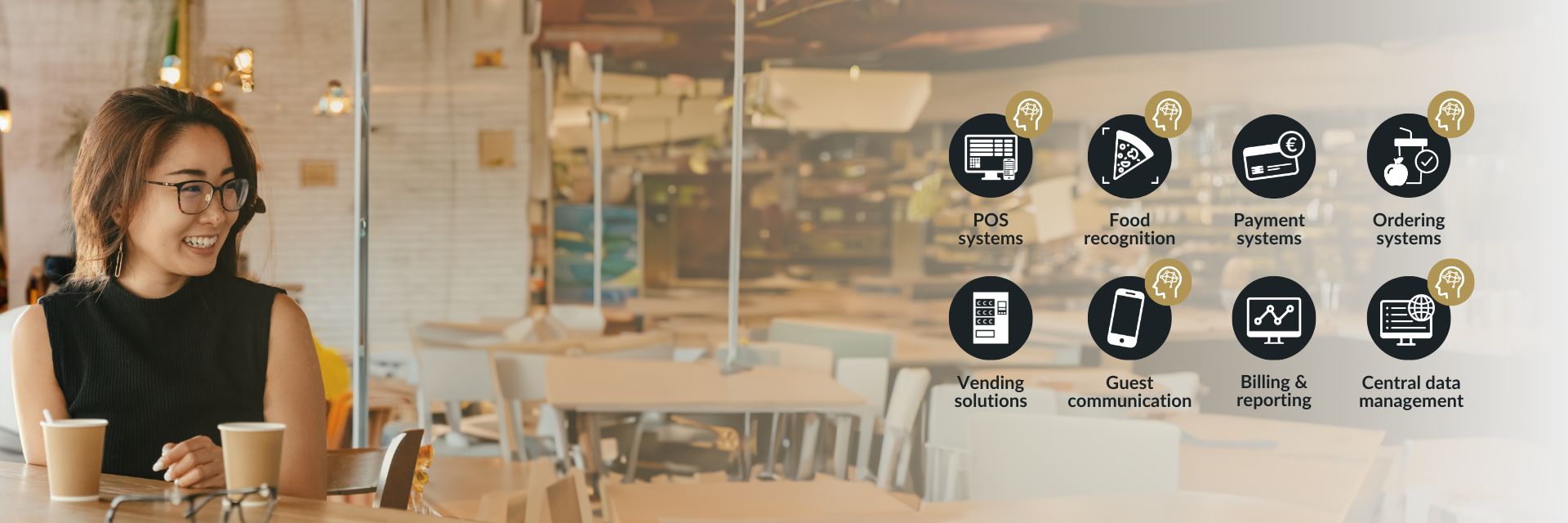
What is a POS system?
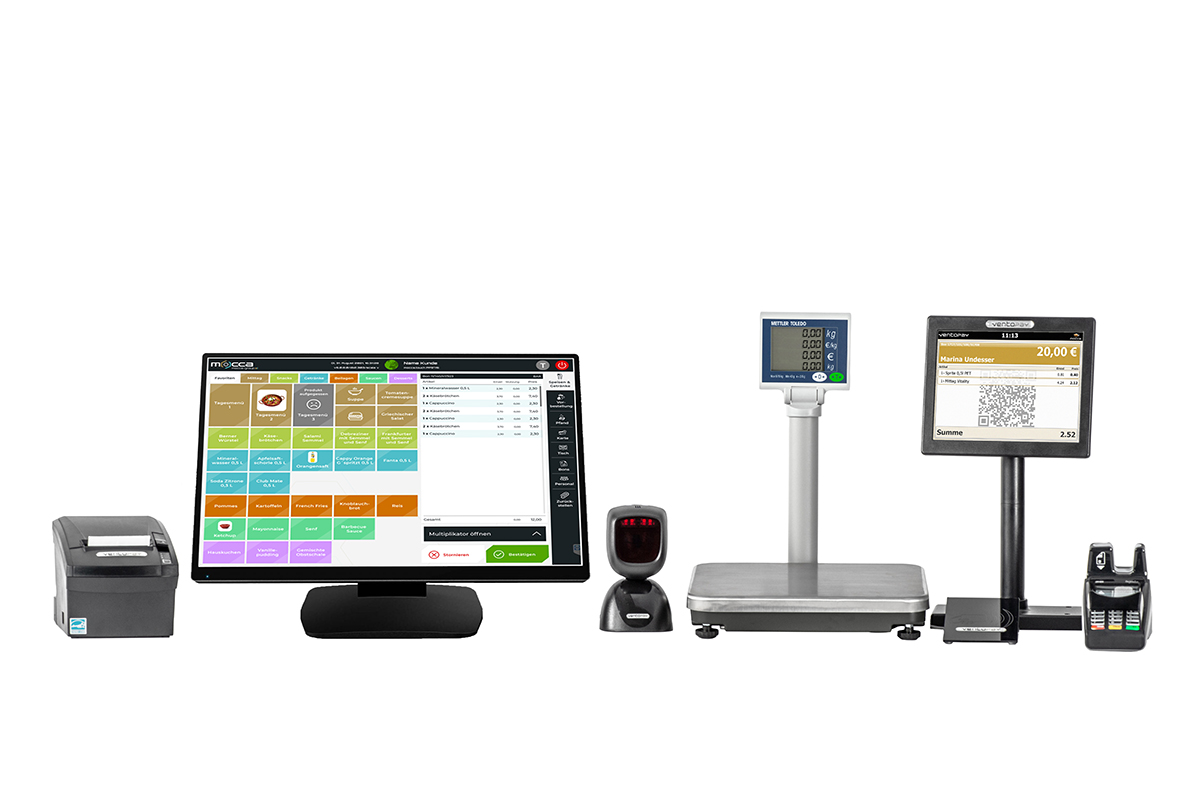
A POS system is an IT-based solution that combines POS software with POS hardware.
Additionally, peripheral devices (such as receipt printers, card readers, barcode scanners, scales, and customer displays) can be connected to the POS system.
Compared to a simple cash register, a POS system offers additional features. The range of functions depends on the desired payment methods and media.
The POS software is the program that handles the checkout process and digitally records the transaction.
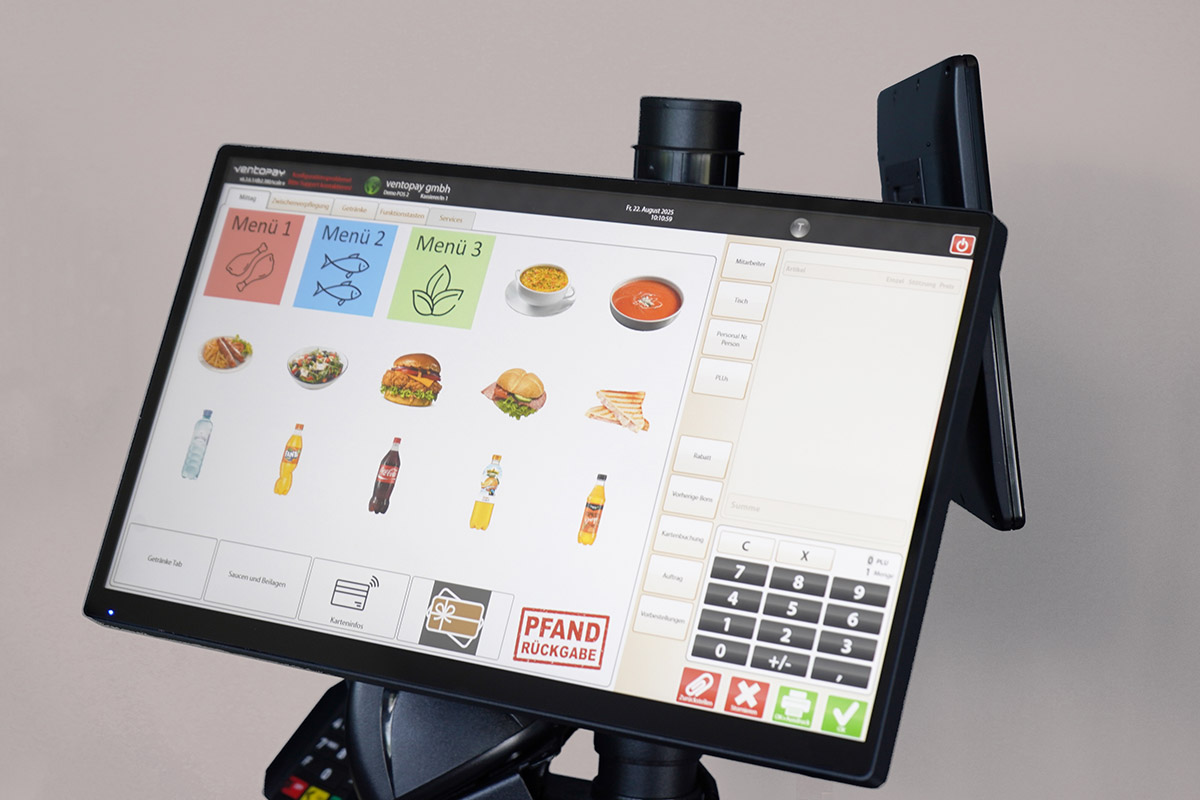
The POS hardware, on the other hand, consists of a computer and a monitor. ventopay offers high-quality all-in-one devices, where the computer is already integrated into the monitor.
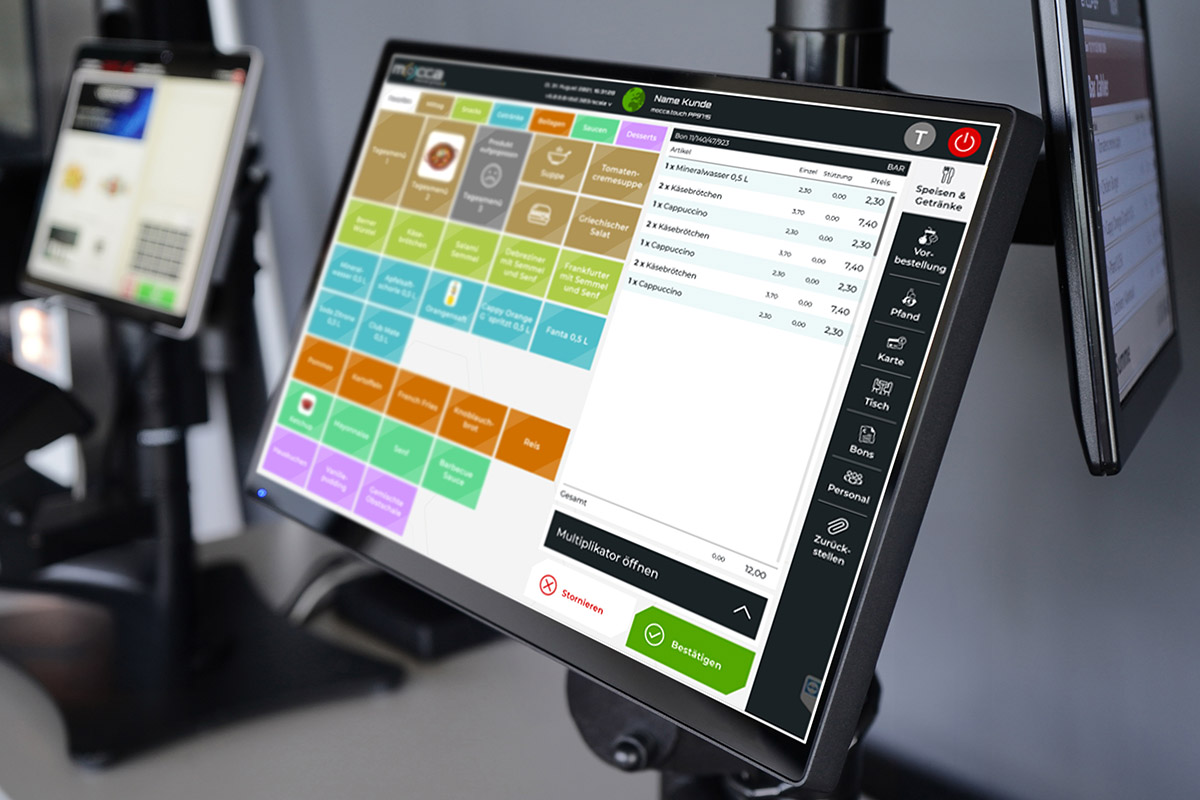
What accessories are available for POS systems?
POS systems can be equipped with numerous accessories, collectively referred to as peripheral devices. The following peripherals, useful for the food service industry, are available from ventopay:
- receipt printers
- cash drawers
- debit card terminals
- card readers
- barcode scanners
- customer displays
- scales
- docking stations
- poles
In a broader sense, top-up terminals are also part of the POS system for food service. These are machines where employees and guests can load credit onto their cards. Cards can generally be topped up using cash, debit card, or credit card, or billing can be handled via payroll deduction. Our top-up terminals can be configured flexibly, offering every food service operator the right options for their needs.
Request a free consultation now!
We are happy to provide you with free and non-binding advice on your new POS system for the food service industry!
What types of POS systems for food service does ventopay offer?
Depending on the intended use, the following POS system models are available for the food service industry at ventopay:
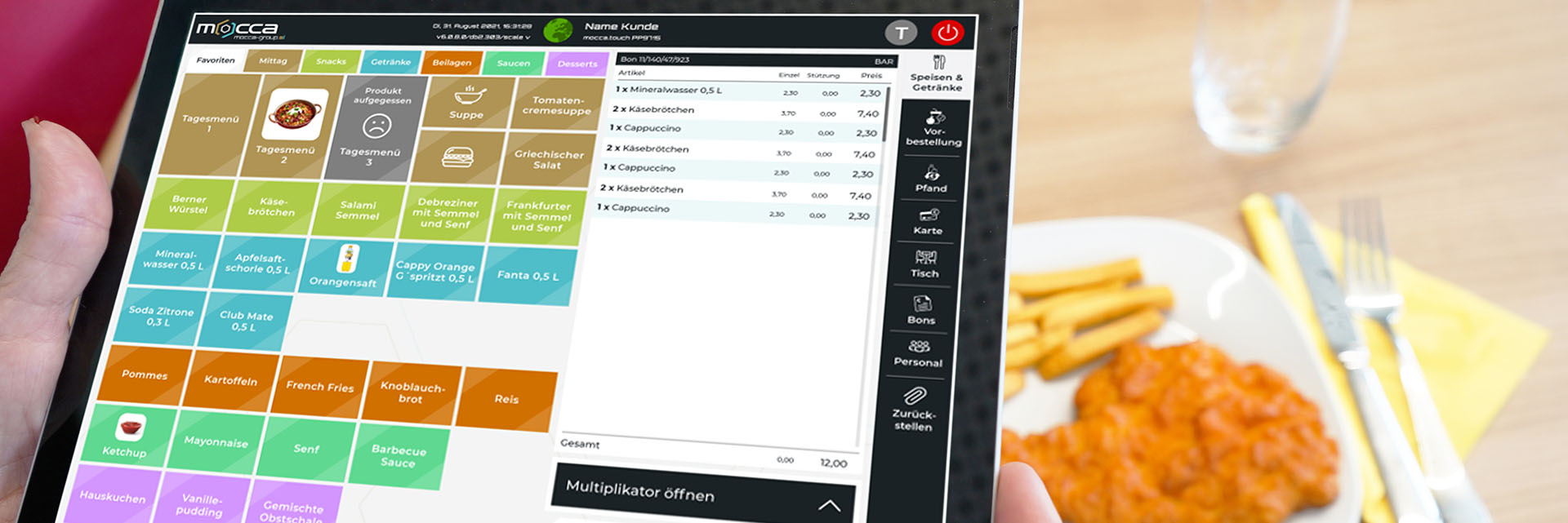
Stationary POS systems
In cooperation with our long-standing supplier, we can offer you a high-performance POS model at an excellent price.
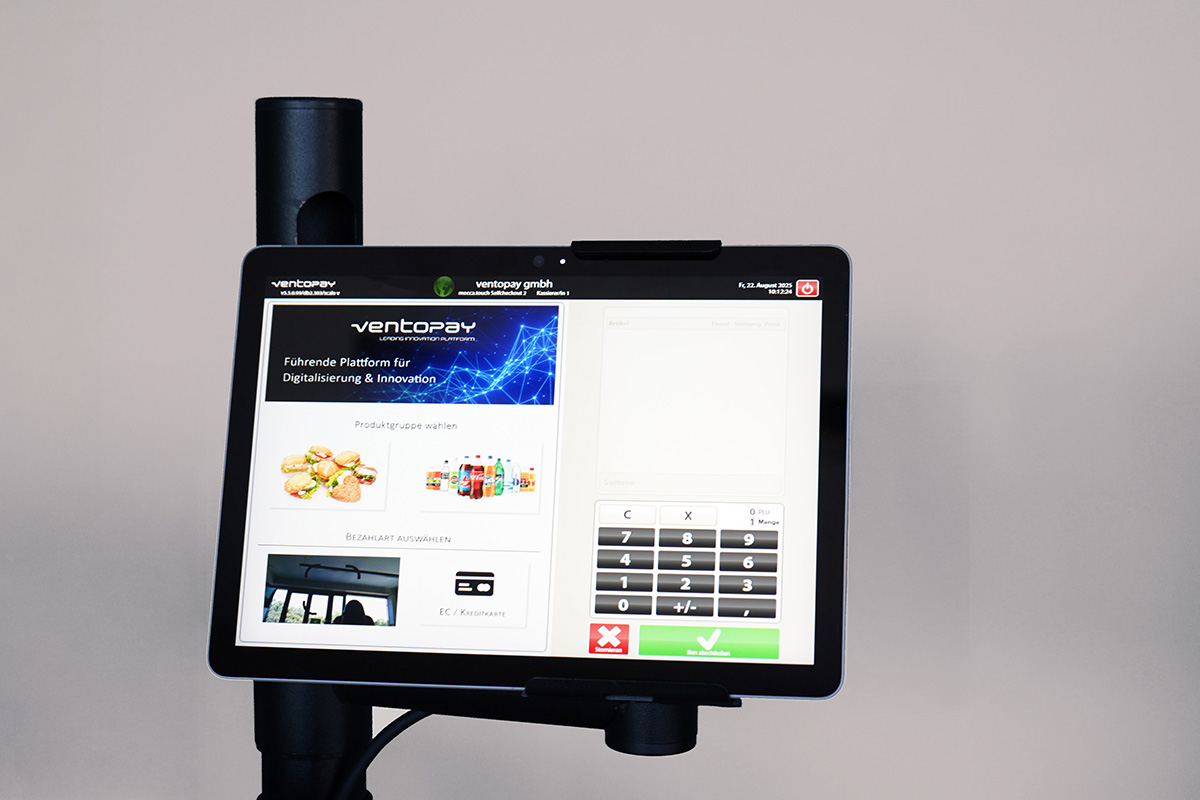
Our POS systems run on Windows, with the entire system specially optimized for the requirements of the mocca® POS software. The customized operating system and BIOS ensure fast startup and smooth operation.
To guarantee maximum performance, the POS systems feature high-quality hardware components, such as:
- Processor: Intel® Core™ i3-1215U
- Memory: 16 GB RAM DDR5
- Storage: 256 GB
Mobile POS systems
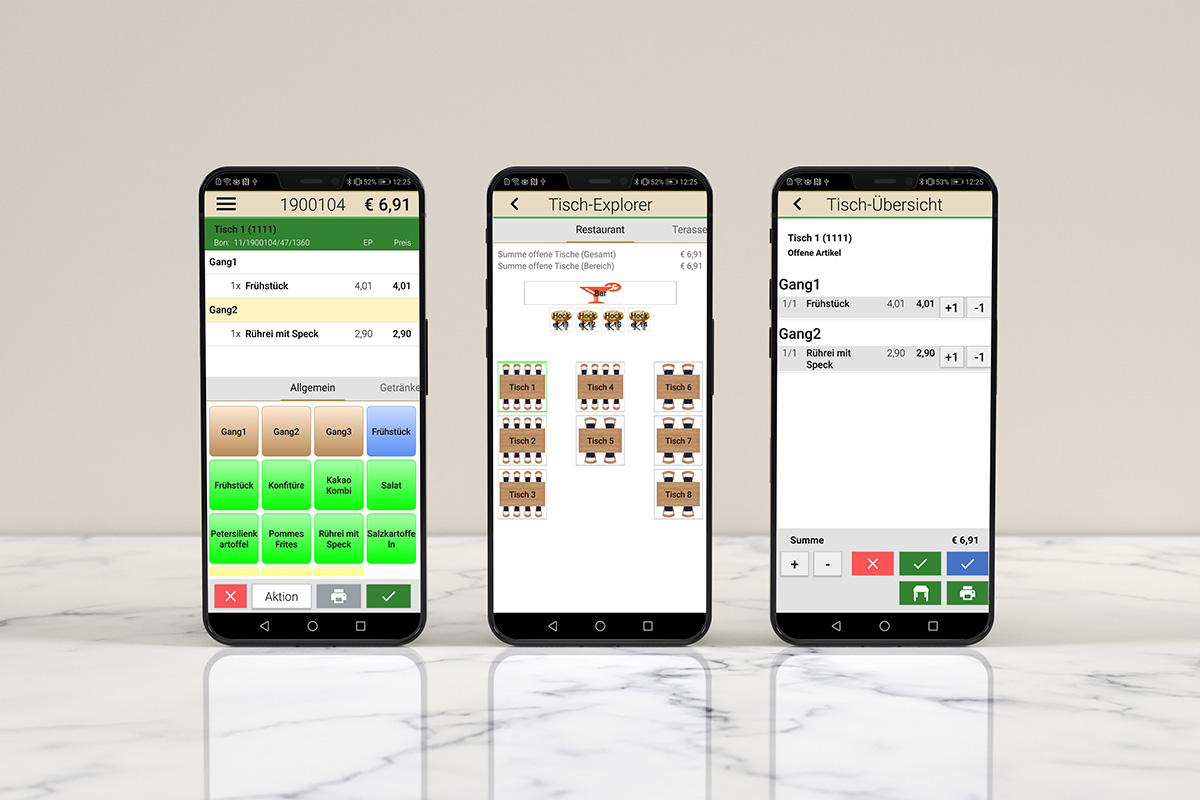
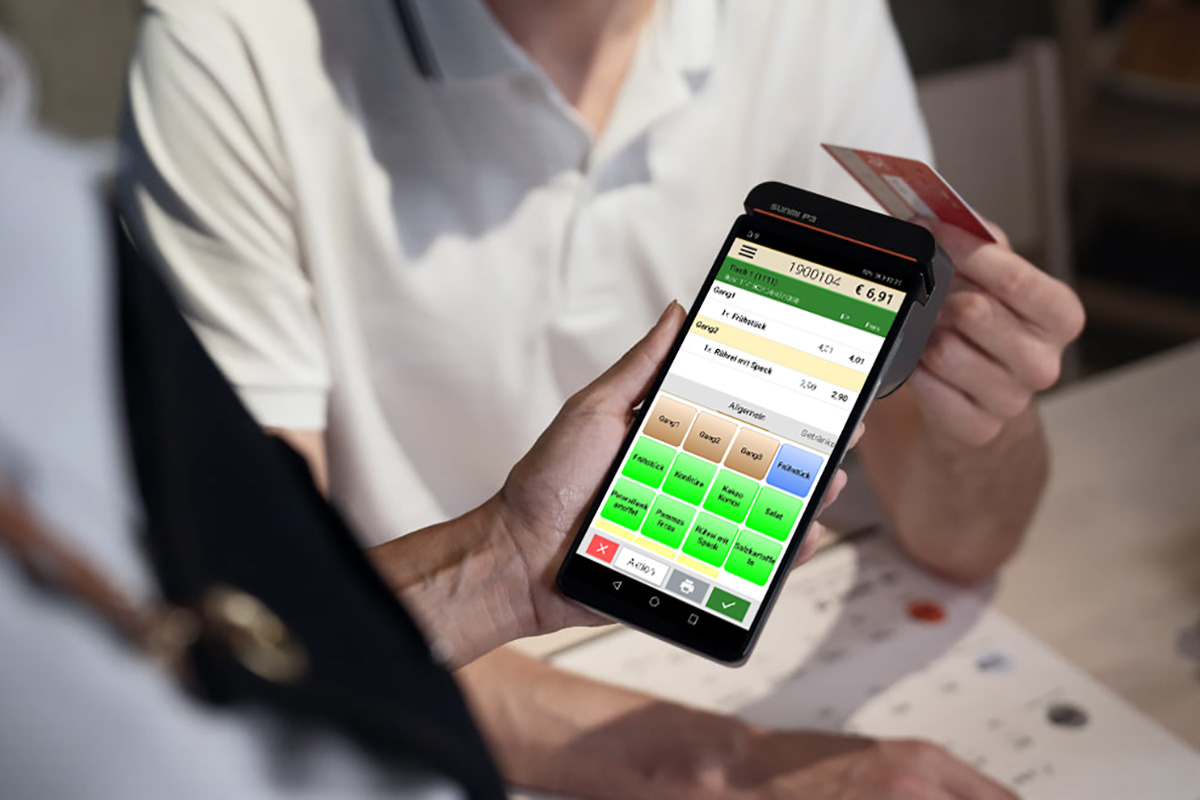
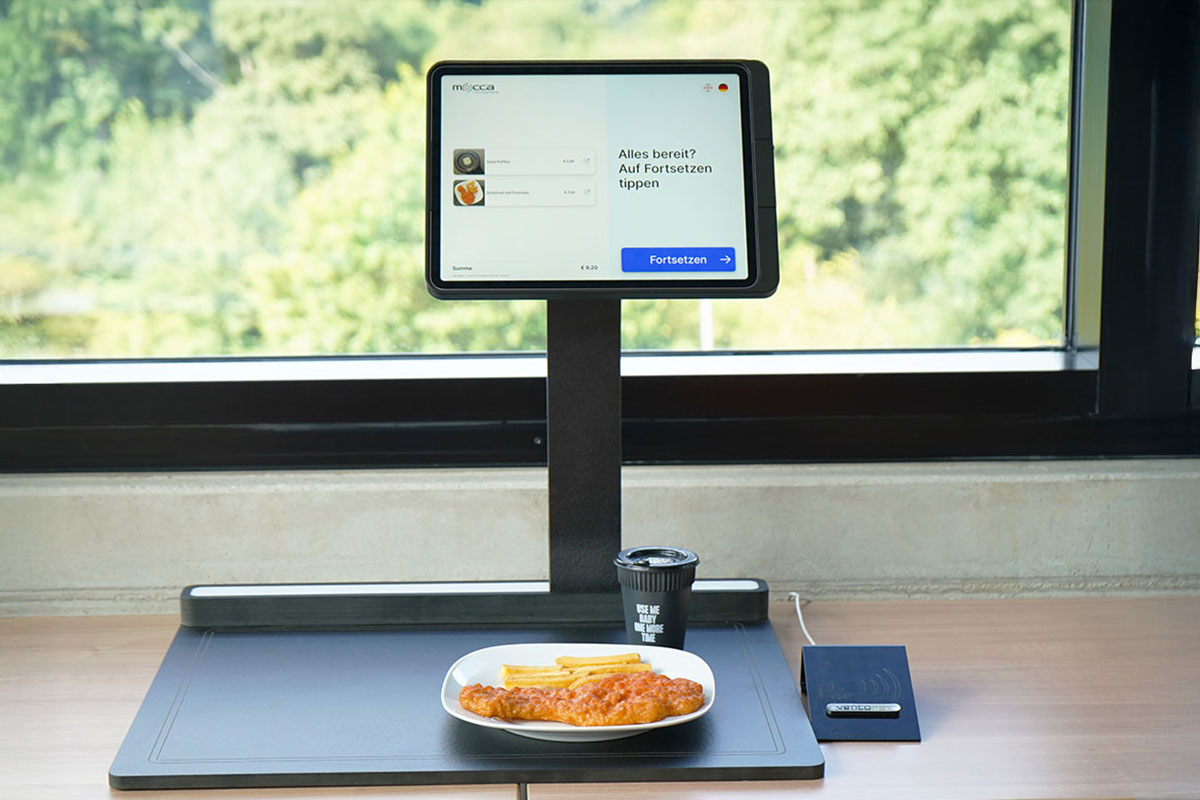
In addition to stationary POS systems, ventopay also offers mobile POS systems for the food service industry, which stand out for their flexibility. The mobile POS system is a tablet available in various sizes.
The mobile POS system provides maximum resistance to drops, dirt, and temperature fluctuations, ensuring a long service life. This makes it ideal for use at different locations within the food service sector.
Like the stationary POS systems, the mobile POS systems feature high-quality hardware components, such as:
- Processor: Intel® Core™ Ultra 5
- Memory: 16 GB RAM
- Storage: 256 GB SSD
Which payment systems does a food service POS system support?
When purchasing ventopay POS systems for the food service industry, you can choose whether to use an open, closed, or hybrid payment system. The ventopay team will gladly advise you. Each system offers different advantages:
Open-loop food service POS system
- no additional payment medium required
- no top-ups necessary
- no clearing process needed
- lower investment costs
Closed-loop food service POS system
- extremely fast and simple payment (0.2 seconds)
- no ongoing transaction costs
- payment card doubles as advertising space
- 100% offline capability thanks to ventopay technologies
Open- and closed-loop food service POS system
- durable, high-quality hardware components
- receipt access at info terminals
- customer loyalty and discount campaigns
- happy hour and fan promotions
- real-time sales analysis
- integration of ticketing and cashback systems
Which payment methods does the POS system support?
In principle, all desired payment methods can be integrated into the ventopay POS system for the food service industry:
- Mobile Payment (QR code, Bluecode, Bluetooth BLE, NFC)
- cash payment
- debit card (EC card)
- debit cards
- Girogo
- ATM cards
- credit cards
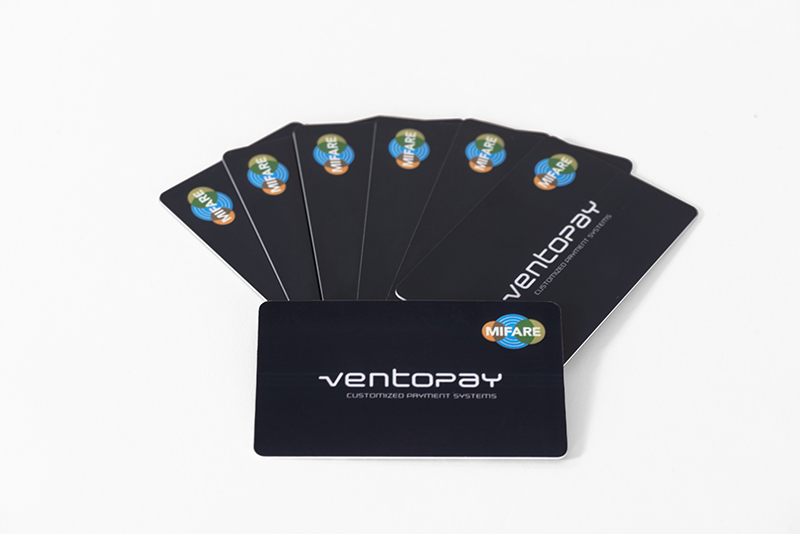
- proprietary payment cards
How much does a POS system cost?
It’s not possible to give a flat rate for the cost of a POS system for the food service industry. The price depends on a variety of factors:
- number of locations or restaurants
- number of POS terminals required
- type of POS systems (stationary, tablet, smartphone)
- required peripheral devices
- desired range of functions
- integration of additional modules and extensions
- scope of services (maintenance, support, etc.)
Additionally, the costs for hardware and software can either be paid in full upon purchase or, when using the system as SaaS (Software as a Service), billed as monthly license fees. The ventopay sales team will gladly provide you with a free, non-binding quote for a POS system tailored exactly to your requirements and preferences.
Request a free consultation now!
We are happy to provide you with free and non-binding advice on your new POS system for the food service industry!
Which services are essential for POS systems?
ventopay offers comprehensive services related to POS systems for the food service industry.
From the very first non-binding consultation, we provide in-depth advice from POS system experts. This expertise continues throughout professional project management during the implementation phase.
Before the system goes live, we conduct training sessions for your staff, ensuring they can handle the first day of operation with ease. If needed, we can also provide a trained ventopay employee to assist during the initial days.
For any questions, requests, or concerns, our support team is always available. And to keep your POS system running smoothly, hardware and software components are regularly maintained.

| Consultation | We are experts in POS systems for the food service industry. The ventopay team is at your disposal to capture all your requirements, develop tailored solutions, and present the latest innovations in POS and payment systems for the food service sector. Our POS systems are widely used by renowned companies. Through intensive knowledge exchange with our customers and partners, as well as our in-house development, we can offer you customized solutions for your food service POS needs. |
|---|---|
| Project management | Our services start before the contract is signed. We ensure perfect advice and support from the very beginning. Take advantage of our many years of experience in planning and implementing POS systems for the food service industry. Our professional IT specialists install your new POS hardware and software and make sure it integrates seamlessly into your existing systems. We take care of schedules, coordination, remote access setup, and organizing all necessary data in advance to guarantee smooth operation of your POS system. |
| Initial setup | ventopay takes care of the precise configuration of the POS software and databases before all cash points and workstations are integrated into the system. Quality assurance measures and internal documentation ensure a perfectly functioning POS system for the food service industry. |
| Training and commissioning | After all POS system components have been put into operation, detailed functionality tests are carried out on-site in the food service environment. During subsequent training sessions, our experts explain all functions of the mocca® POS system to your employees and share tips and tricks for working quickly and efficiently. |
| Support on the first day of operation | During the first day of operation, ventopay staff are on-site in the food service environment to ensure the POS system functions properly. Cashiers are supported by ventopay experts and receive additional training if needed. Assistance with the first daily settlement in the POS system is also guaranteed. |
| Support | Our support team is always available for you. Many questions about the POS system can be resolved instantly via remote maintenance in just seconds. Our service technicians also ensure on-site in the food service environment that everything runs smoothly with your POS system during daily operations. |
| Hardware and software maintenance | Thanks to continuous development and improvements of our POS system for the food service industry, you receive products with a long service life. Regular updates ensure smooth operations in your business. The POS system for the food service industry always runs on the latest version and complies with standards and legal requirements. |
Which laws must be observed regarding POS systems?
POS systems for the food service industry must comply with a number of regulations, directives, and laws.
In Austria, several laws and regulations concerning cash registers have been introduced step by step. The obligation to use a cash register and to issue receipts has been in effect since January 1, 2016. On April 1, 2017, the Cash Register Security Regulation (RKSV) also came into force.
To comply with the law, each cash register must have a technical security device that prevents manipulation of sales data. This requires both a comprehensive software extension and the addition of a hardware signature creation unit to the cash register.
In Germany, the GoBD (Principles for the proper keeping and storage of books, records, and documents in electronic form as well as for data access) have regulated the formal requirements for bookkeeping and the storage of tax-relevant data and paper documents since 2015. They also specify electronic data access during audits by the tax authorities.
To ensure sufficient protection against manipulation and subsequent changes to transactions, the “Law to Protect Against Manipulation of Digital Basic Records” was enacted at the end of 2016. In addition to technical protection against manipulation, it provides the basis for efficient audits through a standardized digital interface.
This relatively broad framework was further specified by an additional regulation – the “Regulation on the Determination of Technical Requirements for Electronic Recording and Security Systems in Commercial Transactions,” known as KassenSichV. The KassenSichV came into force on January 1, 2020.
In summary, the following legal requirements apply to POS systems:
- Cash register obligation and receipt issuance obligation according to BAO (Austria)
- RKSV (Austria)
- GoBD and GDPdU (Germany)
- KassenSichV with TSE (Germany)
- GDPR (Germany and Austria)
ventopay guarantees that POS systems for the food service industry in Germany and Austria are 100% compliant with tax authority regulations.







What functions do ventopay POS systems for the food service industry offer?
The ventopay POS system includes all the necessary functions for smooth operation in the food service sector. The list of functions includes, among others:
- order processing
- table order processing
- cashless payment
- cost center management
- voucher management
- master data management
- reports and statistics
- standardized interfaces to inventory management systems, HR systems, etc.
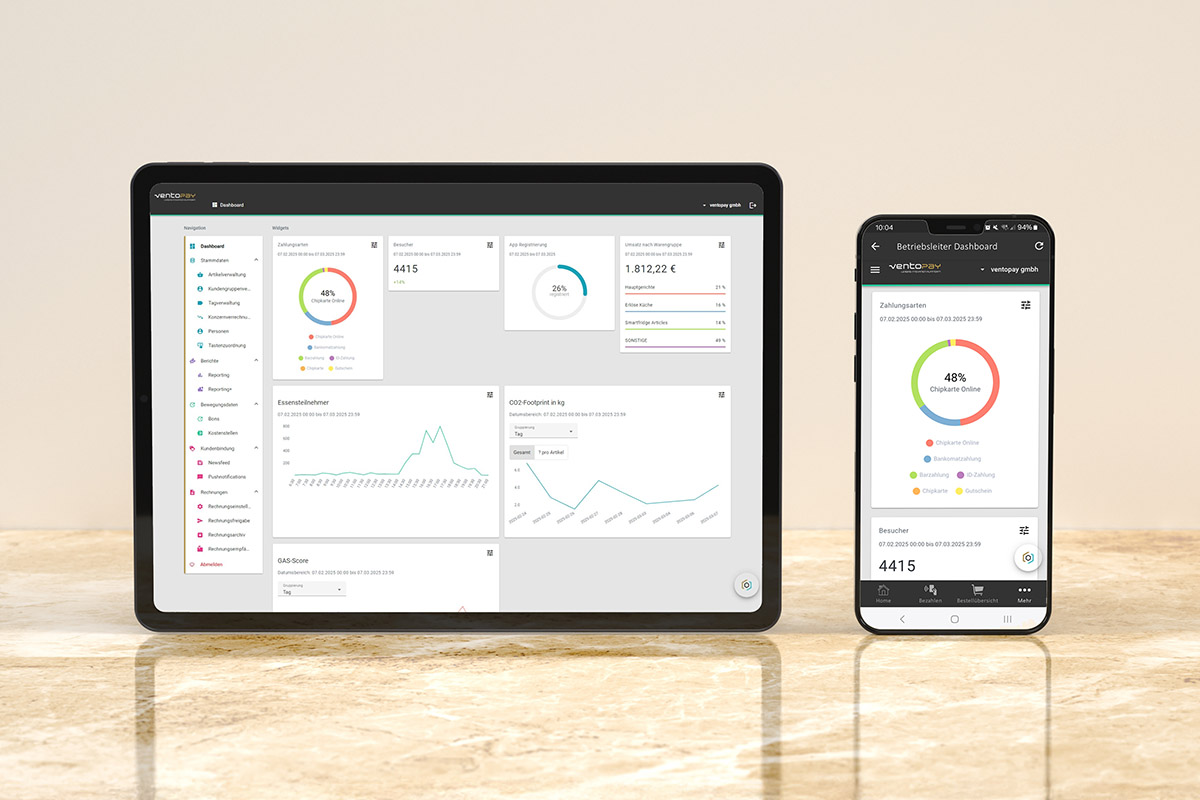
| Centralization | Storing all system data in a central database offers many advantages. Centrally controlled processes instead of multiple executions at each individual POS reduce effort and lower costs. |
|---|---|
| Multi-tenancy | Multi-tenancy means that a software system can be used by multiple tenants – that is, users or customers – without them having access to each other’s user management or data. The advantage of multi-tenant software is that it only needs to be installed once. Maintenance effort is also reduced because it does not have to be carried out individually for each user. |
| Authorization concept | An authorization concept allows user rights to be defined. For example, it can be specified which user is allowed to manage which tenants. It can also be set which personal data, article data, and reports are accessible to a specific person or group. A sophisticated authorization system provides not only security but also clarity and relevance for each individual view. |
| Data protection | Not every user should see or use all functions in the POS system. With an authorization and role concept, all settings in the administration interface can be selectively enabled or disabled. This way, each user only sees the areas for which they have permission. The associated reports should also be limited to the respective user. |
| Customer groups | The administration system must be able to manage multiple different customer groups and companies. It must be possible to define group-specific pricing models, payment methods, and subsidy logic. Using the multi-tenancy feature mentioned above, it is also possible to authorize or exclude individual customer groups from making purchases. |
| Real-time | A modern POS system provides real-time access to sales and card transactions from all cash registers, vending machines, and top-up terminals. This allows current reports to be generated at any time, even during ongoing operations. |
| Offline and online | An offline version of the POS system ensures the necessary flexibility. For example, coffee machines without a network connection can also be integrated into the system. In this case, sales data is stored offline and can be transferred to the central system via USB stick. |
| Report automation | A modern payment and billing system enables automated reporting of daily, weekly, or monthly settlements. Reports should be automatically generated on the server after simple configuration. Optionally, reports can be sent automatically by email to defined recipients or made available to authorized users on the network. |
| Credits | There are also automation requirements in the area of credits. Through an interface, it should be possible to automatically credit one or more cards. For example, when a card is replaced due to loss or damage, the balance should automatically be transferred to a new card. In the case of a cancellation, it is essential that the refund can be processed automatically without presenting the card. When switching to a new wallet system, the balance should also be automatically transferred from the old wallet to the new one. |
| Flexibility | To respond easily and flexibly to change requests, it is important that individual adjustments can be made to cash registers, vending machines, and top-up terminals. The system must also be expandable without major effort. Cash registers, peripheral devices, top-up terminals, vending machine modules, and pre-order systems, as well as restaurants and locations, should be easily integrated into the overall system. |
| POS hardware | Modern POS systems feature robust hardware. High-quality terminals with capacitive PCT touchscreens, 4 GB RAM, and 128 GB SSD represent the minimum requirements. The advantage, besides good usability, is durability. A robust POS terminal can also be cleaned easily and meets hygiene standards. |
| Encryption | POS systems must provide certified IT security. This means that all data on the terminals and the server must be stored encrypted in MS-SQL databases. |
| Offline capability of the POS | POS systems must function even in offline mode. Ongoing operations must not be interrupted. As soon as a network connection is restored, the data should synchronize automatically. |
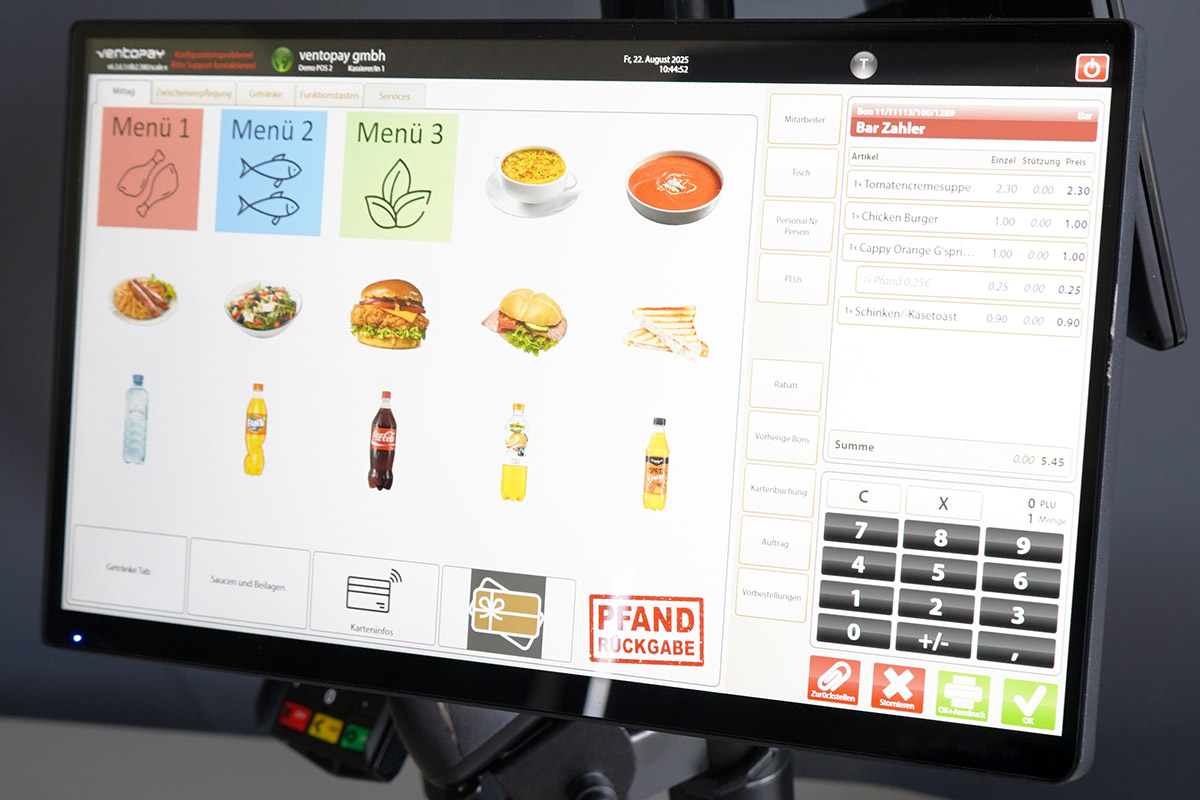
| Article-specific features | To avoid errors – for example with deposit bookings – so-called tandem articles are an important function. When a drink is booked at the POS, the deposit is automatically included. Menu combinations should also be supported, as well as “Happy Hour” offers. |
| Subsidies | POS systems must allow the allocation of subsidies. The corresponding invoices must include all legally required elements for proper accounting. |
| Button layout | The button layout on the POS must be individually configurable. Customers should be able to arrange individual items according to their preferences using drag & drop. Various tabs should be available for improved clarity. |
| Balance top-up at the POS | For large companies, operating machines for balance top-up saves time. Small businesses can avoid the cost of a top-up terminal if the POS system directly supports top-up and deduction functions. |
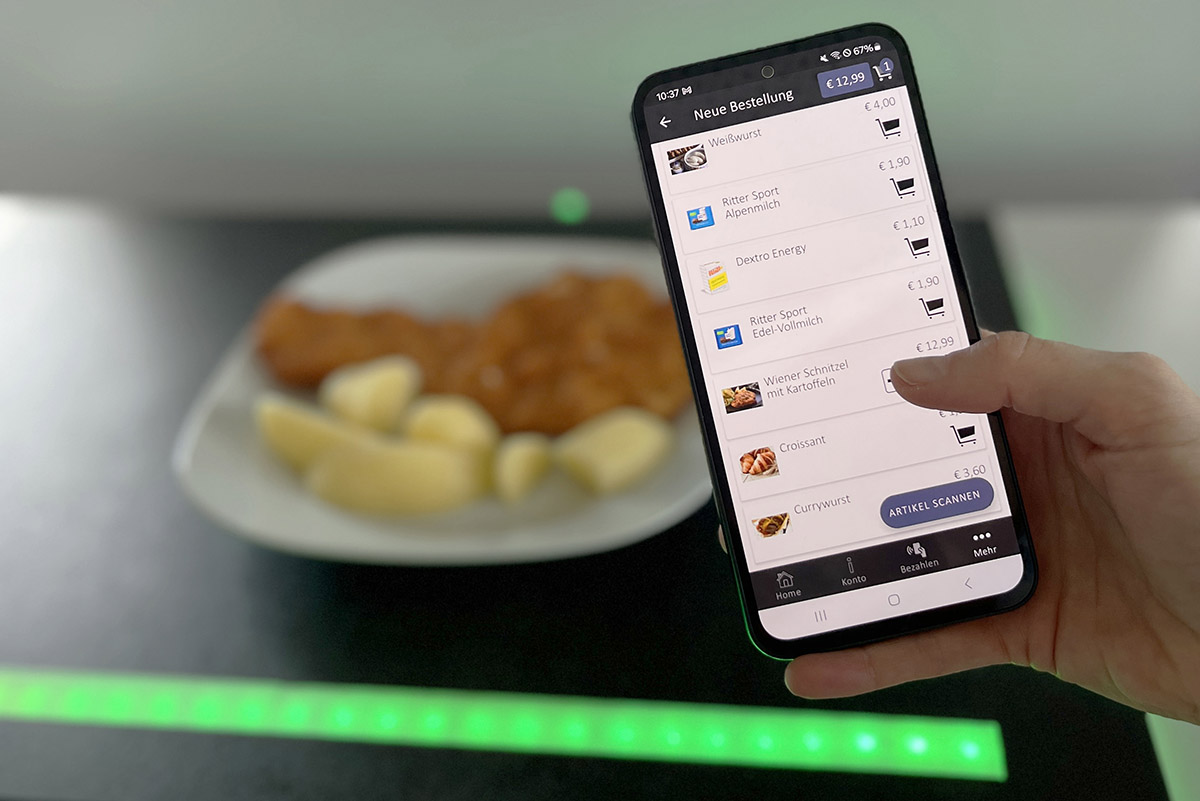
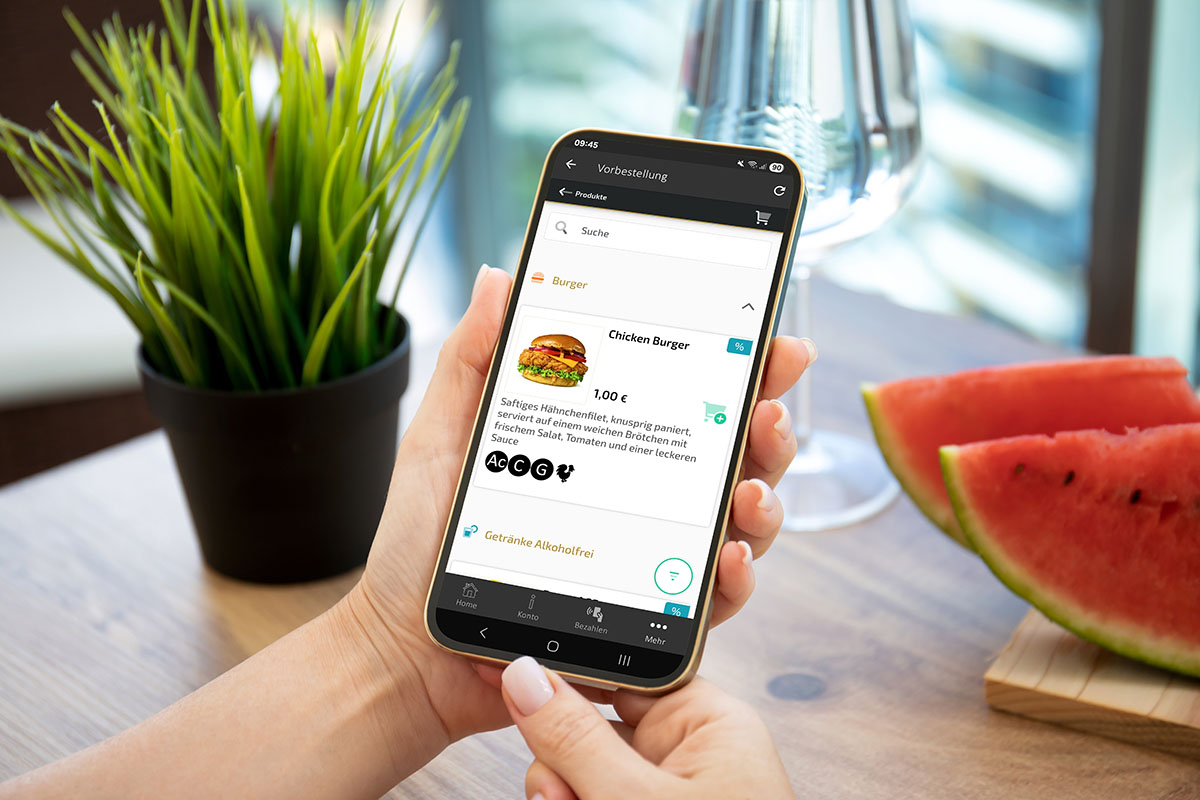
| Self-service operation | Another requirement for a modern POS system is the option for self-service operation. This allows the POS to be operated without staff – guests scan or book their purchases themselves. |
Request a free consultation now!
We are happy to provide you with free and non-binding advice on your new POS system for the food service industry!
What are the advantages of ventopay POS systems?
By using the ventopay POS system for the food service industry, you benefit from numerous advantages. Some of these include:
- future-proof complete system: everything from a single source
- innovative POS system through integration of research results and use of the latest technology
- high-performance hardware and software
- intuitive operation of the POS system
- easy expansion with additional modules
- standardized interfaces to third-party systems
- centralization of all data
- offline capability of the POS system
- data and IT security
- 100% compliance with tax regulations
Further advantages of the ventopay POS system for the food service industry in detail:
| Complete system – unified data basis | In the mocca® complete system, many added values can be created based on the central data basis. The software and its architecture enable flexible extensions and long-term scalability of the system. Innovations and system expansions can be implemented quickly and cost-effectively on this unified basis. Examples include: • Printing receipts from cash registers and vending machines at top-up terminals • Discounted coffee/snack at vending machines when defined items are purchased at the cash registers • Guests can access everything from receipts to nutritional information transparently in the app • All system components can be managed from a central software platform (POS, payment system, vending modules, apps, digital signage) • Integrity and fast implementation of customer-specific requirements are ensured without the need for costly interfaces between multiple systems |
|---|---|
| Many years of experience with centralization and multi-tenancy | The long-proven, centralizable use of the system offers you maximum security. Flexible authorization systems regulate access rights for individual user groups. Thanks to the unified item master, evaluations and comparisons across the entire DACH region are simple and quick. Operation takes place centrally without requiring customer servers and access for configurations. |
| Modular system architecture | The mocca® solution adapts precisely to your needs. For your customers, you can select the exact components from the entire portfolio: • POS terminals, mobile POS, and stadium POS • Self-service solutions • Top-up terminals and guest card systems • Pre-order systems • Customer loyalty apps • Digital signage • Vending modules All components are seamlessly integrated into the complete system – including proactive monitoring. |
| High integration density and openness for additional systems | Despite the high integration density, the system remains open for additional systems. Existing payment systems can be integrated just as easily as inventory management systems. Plugins for apps are also possible. If you want to use your own app, we provide the data conveniently via a SOAP web service. |
| Marketing tools already integrated | With the mocca.loyalty app extension, we can offer you a system that can be quickly deployed as a highly efficient customer loyalty tool. In your design and with extensive information from inventory management and POS, you can offer guests attractive bonus programs or motivate them to consume more during off-peak times. We are currently working on an extension that will allow managers to view real-time sales data directly in the app. |
| Generic interface connector – fast adaptation to pre- and subsystems | Many customers bring many requirements and wishes. With mocca®, you get a system that can quickly adapt to customer needs. Interfaces, in particular, can be parameterized via a generic interface connector and do not need to be reprogrammed. This significantly simplifies work during implementation phases. |
| Loss prevention already integrated | With our management reports, detecting irregularities is already highly efficient. In the clear mocca® reports, you always have deviations in view. We pay special attention to: • Cancellations • Free price entries • Negative bookings • Credit deposits |
|---|---|
| Data warehouse system for fast evaluations and data sharing | To avoid running evaluations on the productive database, a powerful data warehouse system has been implemented in mocca®. Reports can be generated quickly over long periods without affecting ongoing operations. This reporting database is also an ideal data source for additional BI tools. |
| Automated reporting | Automated reporting gives you more time for your core business. All reports are configured once during the setup phase and then generated automatically by the system. This prevents errors in filtering and ensures that all reports are created and, for example, sent by email. |
| Utilizing revenue potential through capacity management | Provide your guests with a clear overview of occupancy in individual restaurant areas. Using the mocca® system and real-time data from POS transactions, the number of available seats can be estimated. This information can easily be integrated into existing digital signage solutions or into mocca.digitalsignage via web services. |
|---|---|
| Individual bonus programs possible | Create incentives with the integrated loyalty system to turn your customers into regulars. Off-peak times can also become more attractive through additional bonus points for your guests. With the seamless integration of the bonus program, guests can check their points balance at the top-up terminal and be motivated to collect more points. The bonus program is also fully integrated into the app. Vouchers can be scanned and redeemed directly at the POS using a QR code. |
| Research project for predicting food demand | Digitalization – health – personalization – mocca® addresses these important megatrends in its ongoing development. With the goal of reducing food waste, increasing sales, and delighting guests, ventopay has been investing intensively in data mining research for about three years. Based on centrally available data, precise predictions of food demand will be possible in the future. Through seamless integration of the table guest via web and app, you benefit from quick customer feedback and customer enthusiasm through personalized offers. |
| Feedback system | The feedback system currently being implemented allows feedback requests to be linked to events – such as voucher redemption. This ensures a high willingness of customers to provide feedback and guarantees that feedback questions always relate to the customer’s recent purchases. This significantly improves the quality of feedback. |
| Proactive system monitoring | With the specially developed tools "Cashpointmonitor" and "Statusreporter," the complete system offers flexible monitoring. If irregularities occur, support staff are notified by email. Many issues are detected by these tools before they have any negative impact. The system landscape can also be integrated into other monitoring tools such as Nagios. |
|---|---|
| Quality by design | In addition to strong innovation, ventopay focuses on product quality. Scalability and expansion options are based on a modular software concept. Load-balancing methods ensure that the software performs well and remains responsive even during peak loads. |
| Software rollout via Windows Update and WSUS process | Complex update routines are a thing of the past with mocca®. The entire software (including database updates) can be packaged and deployed via Windows Update functionality. Central control of which cash points receive an update is possible, as well as monitoring the release status. |
| Combining real-time capability with offline capability | Real-time reports, discounts at coffee machines based on purchases at the POS, or automatic shopping cart analysis and display of nutritional values in the app immediately after purchase – these are just a few examples of the advantages of a real-time capable system. mocca® combines this real-time capability with offline functionality, ensuring that even in a network outage scenario, operations at the POS continue without interruption. |
What does the POS system for the food service industry look like in action?
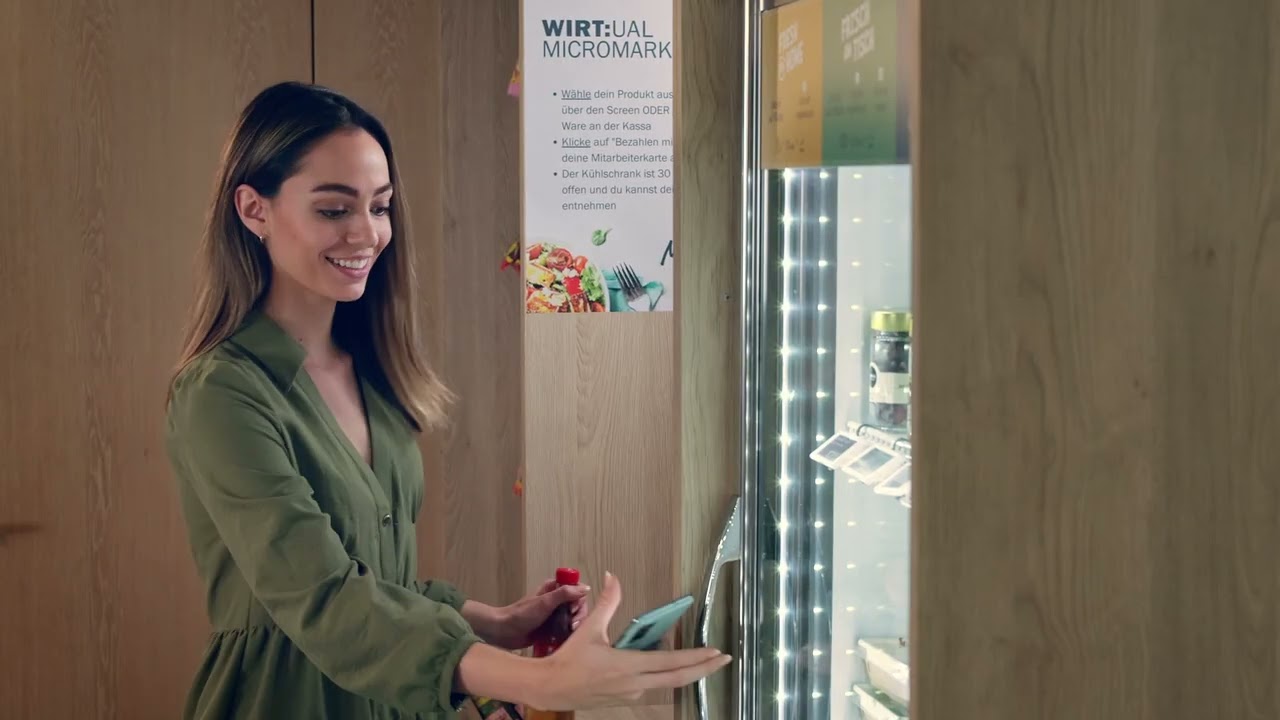
By downloading the video you accept the privacy policy of YouTube.
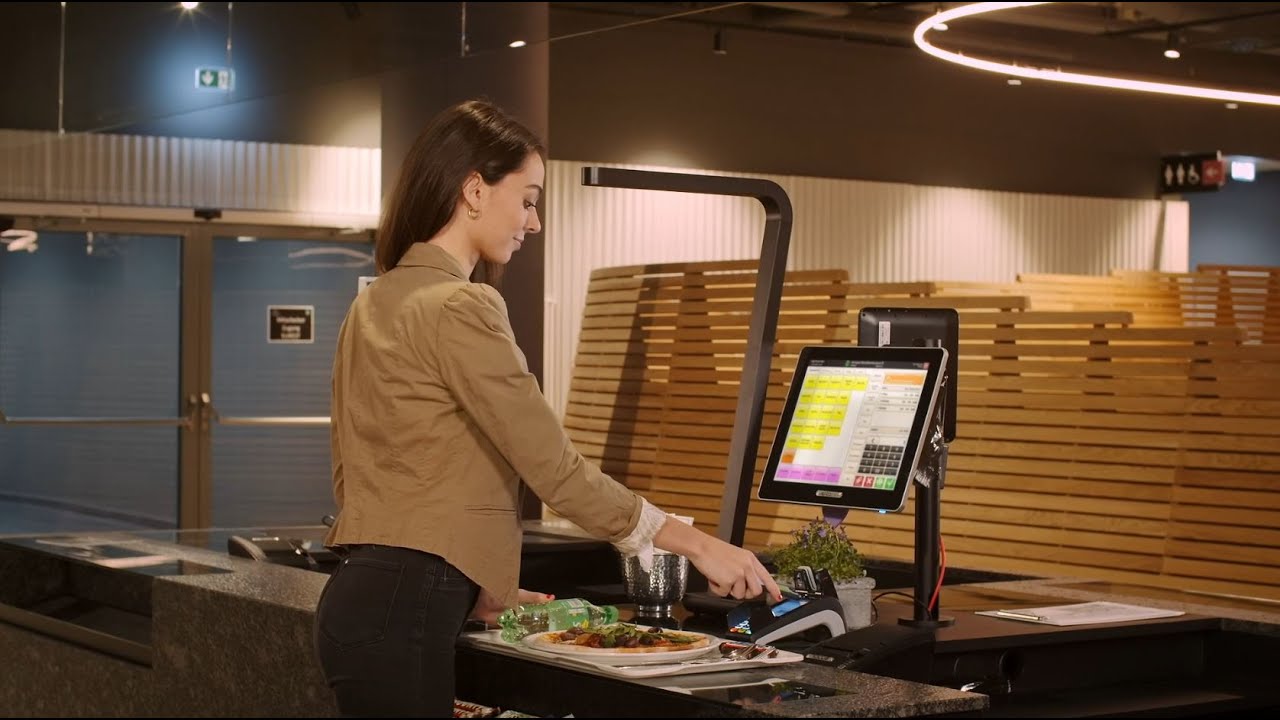
By downloading the video you accept the privacy policy of YouTube.
What does the complete mocca® system overview look like?
For which industries does ventopay offer POS systems?
ventopay specializes in community catering. Specifically, ventopay offers POS systems for the food service industry in the following areas:
What references does ventopay have in the field of POS systems for the food service industry?
ventopay serves hundreds of customers at 1,000 locations with more than 10,000 cash points throughout the DACH region. Customers include many well-known corporations. Around 820,000 transactions are processed daily through mocca® systems. In total, this amounts to more than 300 million transactions per year.
Inquire now without obligation!
We are happy to provide you with free and non-binding advice on your new POS system for the food service industry!
5 reasons
for ventopay
- innovation and technology leader with 25 years of industry experience in community catering
- digitization and automation simplify your daily work and workflows
- overall system provider for cash register, payment, billing and customer enthusiasm systems
- tailor-made solutions through high investments in research & development
- competent, technical support and over 100 service locations in Germany, Austria and Switzerland
Inquire now without obligation!
Contact person search
Technical support team
If you have technical problems, our support team will help you quickly and easily:
AUT: +43 5 7236 – 400
GER: +49 201 874697 – 65
CH: +43 5 7236 – 400